You can have efficient routes and still end up with a messy day. Jobs are left over, schedules slip and your most experienced people collect the easy tasks. Or a job goes to someone who has never been to the site, and it drags on.
Usually the tool is only optimizing the driving. This article covers what route optimization solves, what it leaves open and what mobile workforce optimization does differently.
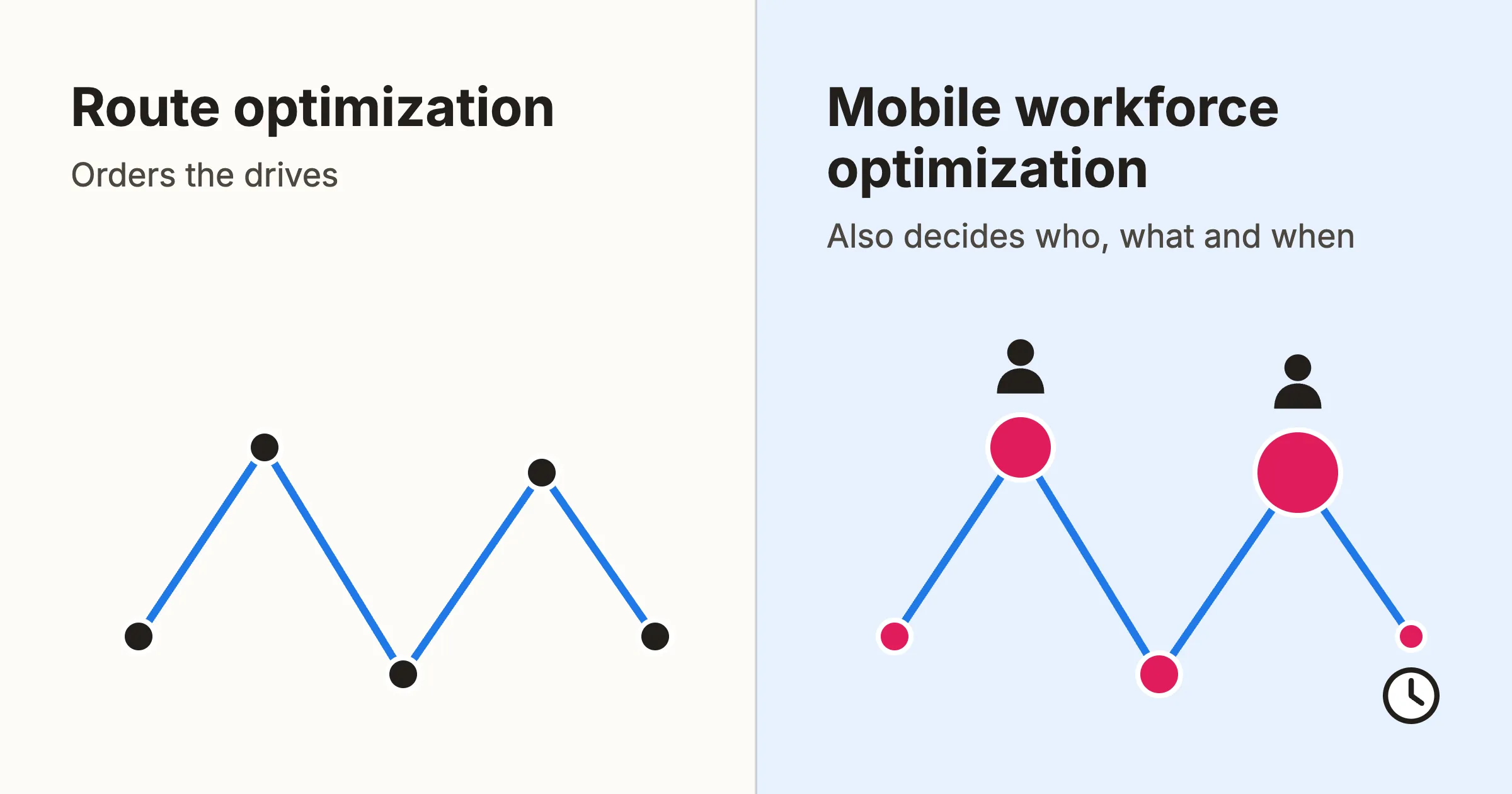
What route optimization does
Route optimization finds the shortest or fastest route for jobs that have already been decided and assigned. It uses heuristic methods, which are decision-making techniques that find a good enough solution quickly, even for a complicated problem, when calculating the perfect one would take too long.
Better data improves the result, for example live traffic and fuel consumption. In freight logistics this cuts costs and speeds up deliveries.
What route optimization does not cover are the questions that decide a field service day: which jobs matter most, who gets them, and how the schedule fits each person’s skills and each customer’s needs. It assumes those are already settled.
What mobile workforce optimization takes into account
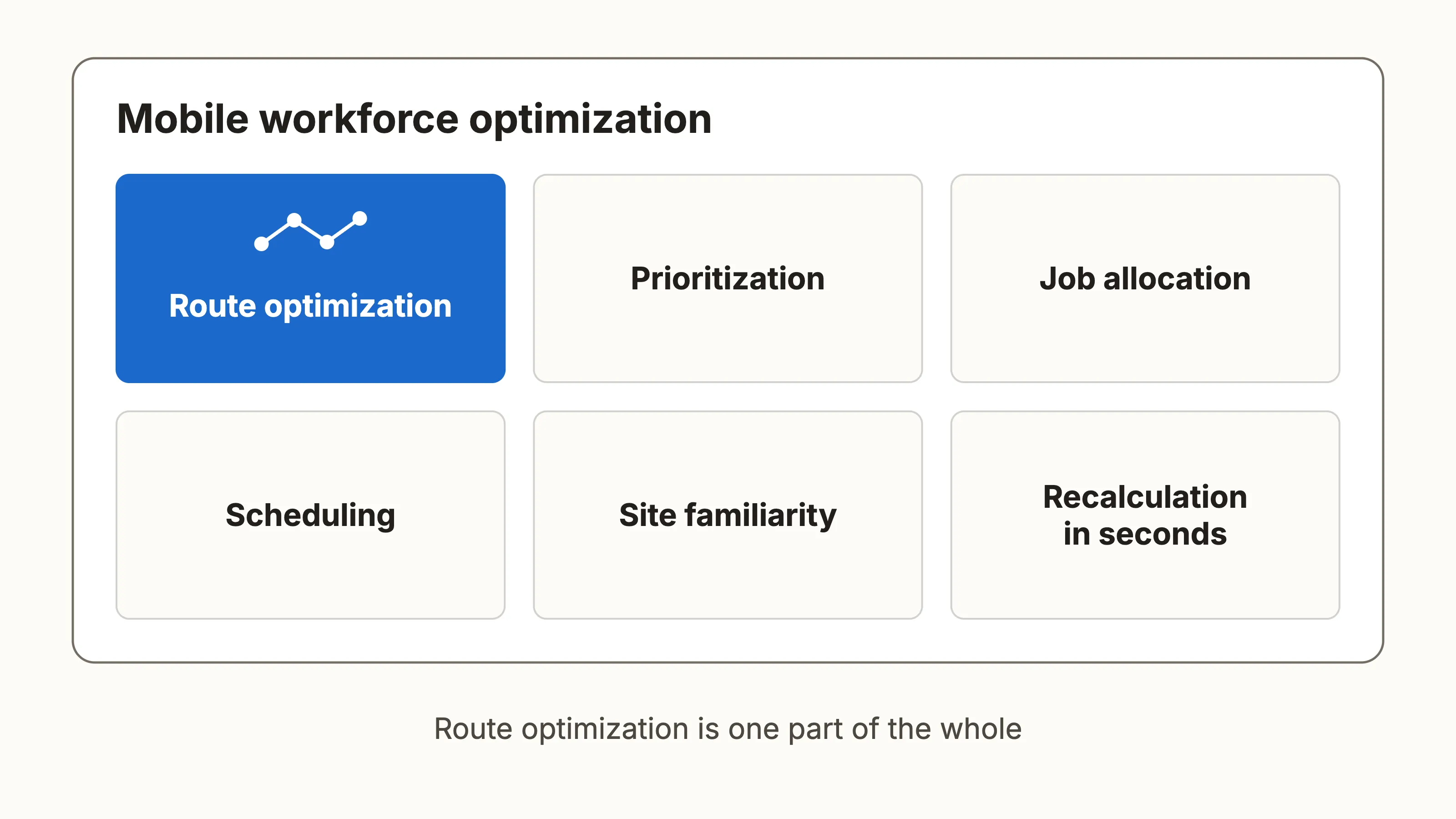
In mobile workforce optimization the route is one part of the plan. The same calculation decides job allocation, sequence and schedule.
For prioritization, the system weighs how urgent a job is and what it is worth to the business. The most important work gets done on time even when not everything fits in the day.
For allocation, jobs go to people by skill, location and working hours. A tricky fault diagnosis goes to the person who can handle it, and a routine inspection to whoever is nearby.
For scheduling, urgent and demanding jobs are fitted around the rest so that idle time stays low. When someone calls in sick or an emergency job appears, the plan is recalculated in seconds.
A fourth factor is easy to miss, although every dispatcher knows it: who knows the site.
Site familiarity: why the person who knows the site should go there
Site familiarity means the optimization knows which workers have been to a site before and counts that as an advantage when allocating the job.
In the field this is obvious. Someone who knows the site knows where the keys are collected, where the technical room is, who to call on the customer’s side and what was done to the equipment last time. A first visit almost always takes longer. Customers also notice whether a familiar face turns up or someone who needs everything explained from scratch.
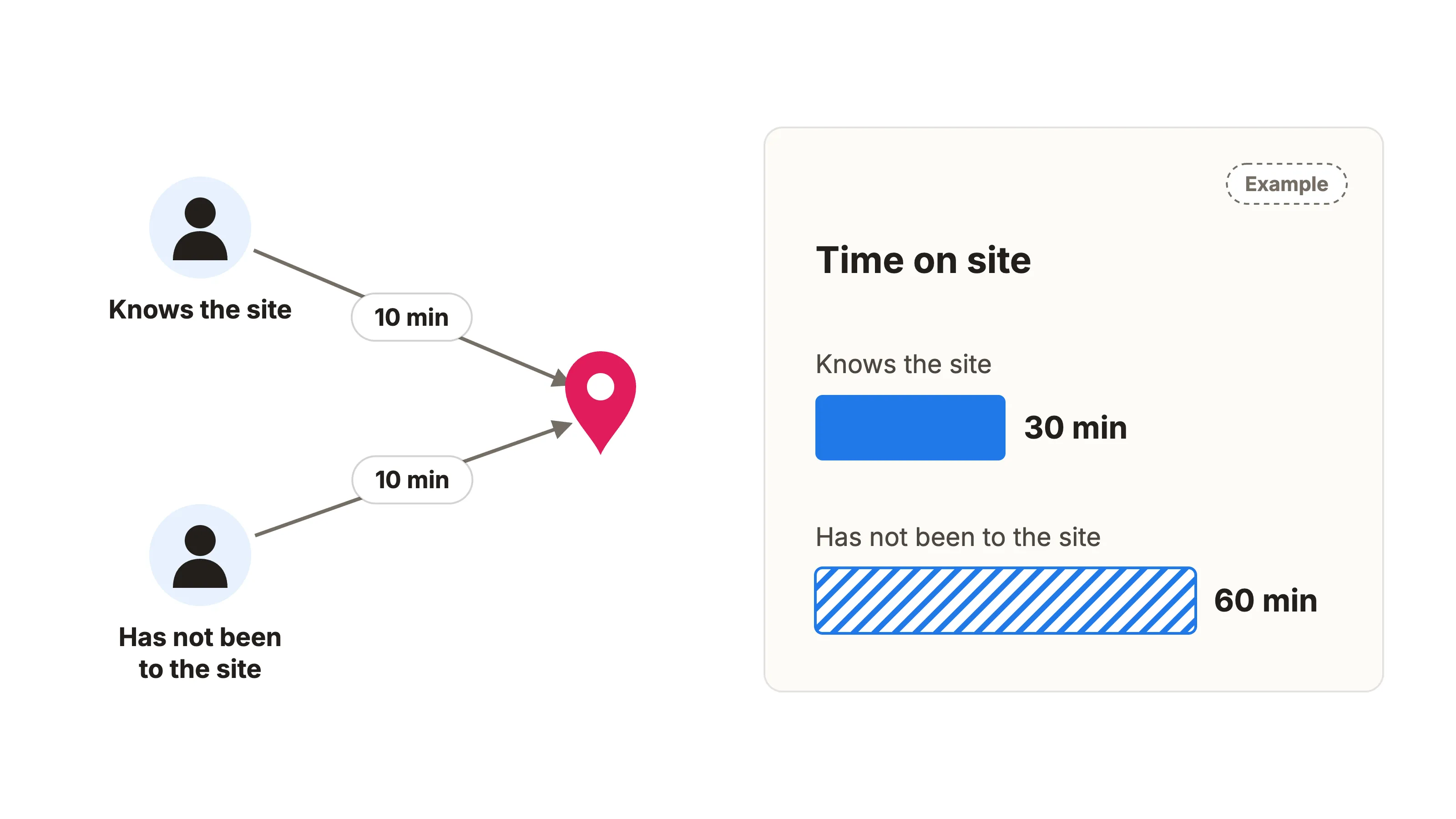
Pure route optimization cannot see this. Picture two technicians who are each ten minutes from the site. One has been there before, the other has not. To a route optimizer they are equal, and the job goes to whoever fits the route better by a few minutes. If the job takes the familiar technician thirty minutes and the other one an hour, the extra thirty minutes on site far outweighs the minutes saved driving.
Familiarity should not tie a site to one person, though. If the familiar worker is on leave or already fully booked, the job has to be able to go to someone else. That is why familiarity works best as a weight the optimization balances against drive time, urgency and workload.
In cleaning and facility services, sites are permanent: customers ask for a familiar cleaner, and a familiar cleaner is faster. In maintenance and field service it is more often about the equipment base and the customer’s habits.
Route optimization and mobile workforce optimization compared
| Question | Route optimization | Mobile workforce optimization |
|---|---|---|
| What it decides | The driving order for assigned jobs | Job allocation, sequence and schedule |
| Inputs | Stops, addresses, traffic | Jobs, workers' skills and hours, urgency, economic value, site familiarity |
| Who does the job | Decided beforehand | The optimization proposes |
| Handling changes | The route is recalculated | The whole plan is recalculated in seconds |
| Best suited to | Delivery work where jobs and drivers are alike | Maintenance, field service, cleaning and other work where jobs and people differ |
How Allocator solves it
Allocator is Dynamik’s software for mobile workforce optimization. It calculates routes, job allocation and schedules together.
Each job, worker and transition can be given its own economic weight. The optimization then favors what costs or earns the most in your business, whether that is drive time, an urgent customer or sending someone who knows the site.
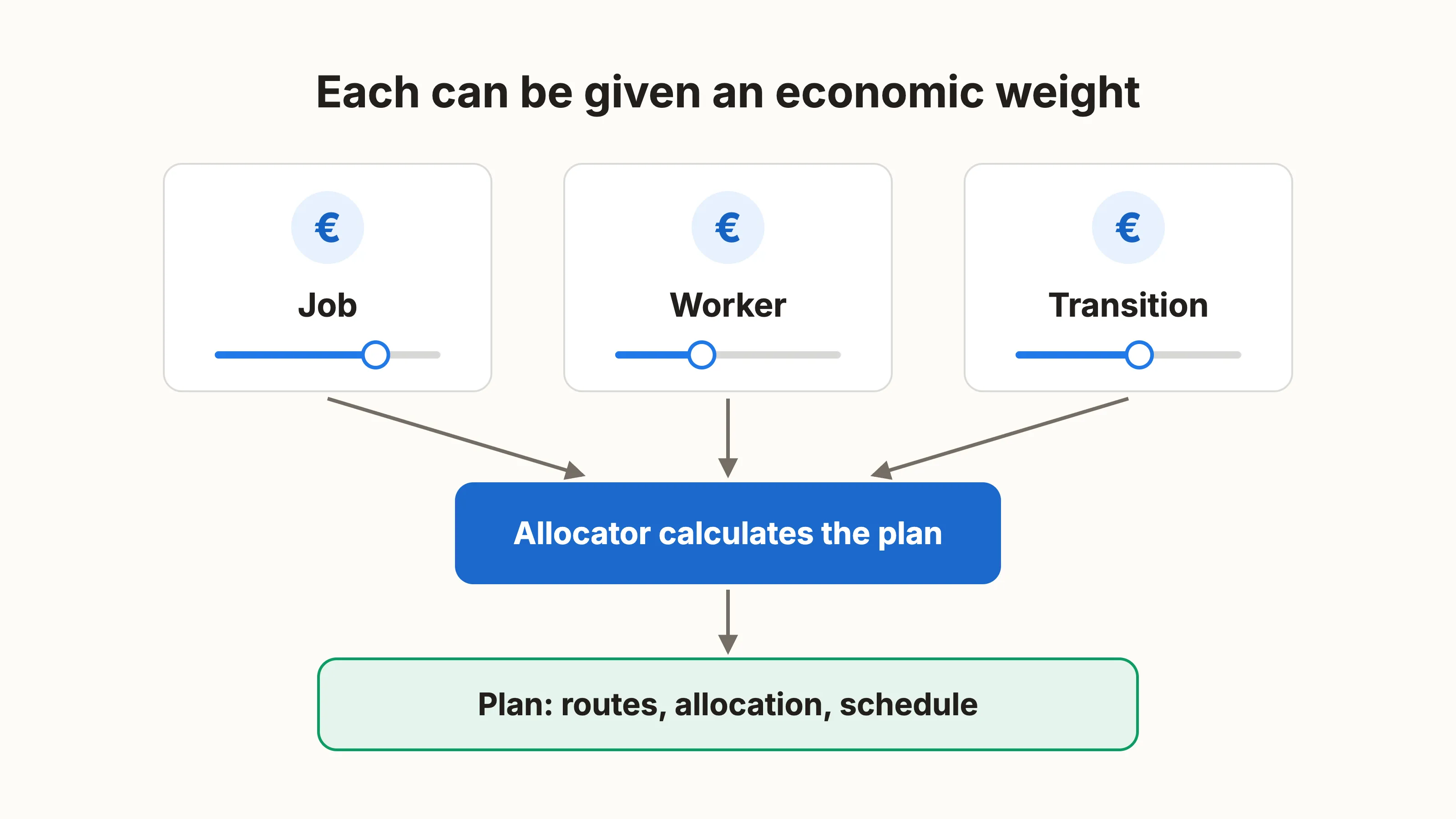
Changes to the schedule or the job queue are handled in seconds. Allocator produces a ready plan, and the planner can always edit it by hand.
Allocator users have reported up to 20% improvements in resource efficiency and in the amount of billable work. In practice the same team gets more work done, or the current workload is handled with fewer people.
Site familiarity is already routine in cleaning: Allocator keeps track of who has been where, and favours a familiar worker both for regular visits and for cover. At Ametro, new customers are offered the best cleaning slot and a permanent cleaning pair in real time, as the Ametro customer reference describes.
Measured results are in the Field work, reallocated whitepaper: in three test optimizations, kilometers driven fell by 31% and 29% at two maintenance companies, and the billable share at a cleaning company rose from 76% to 90%.
If the routes look fine but the days do not, we can look together at why.
